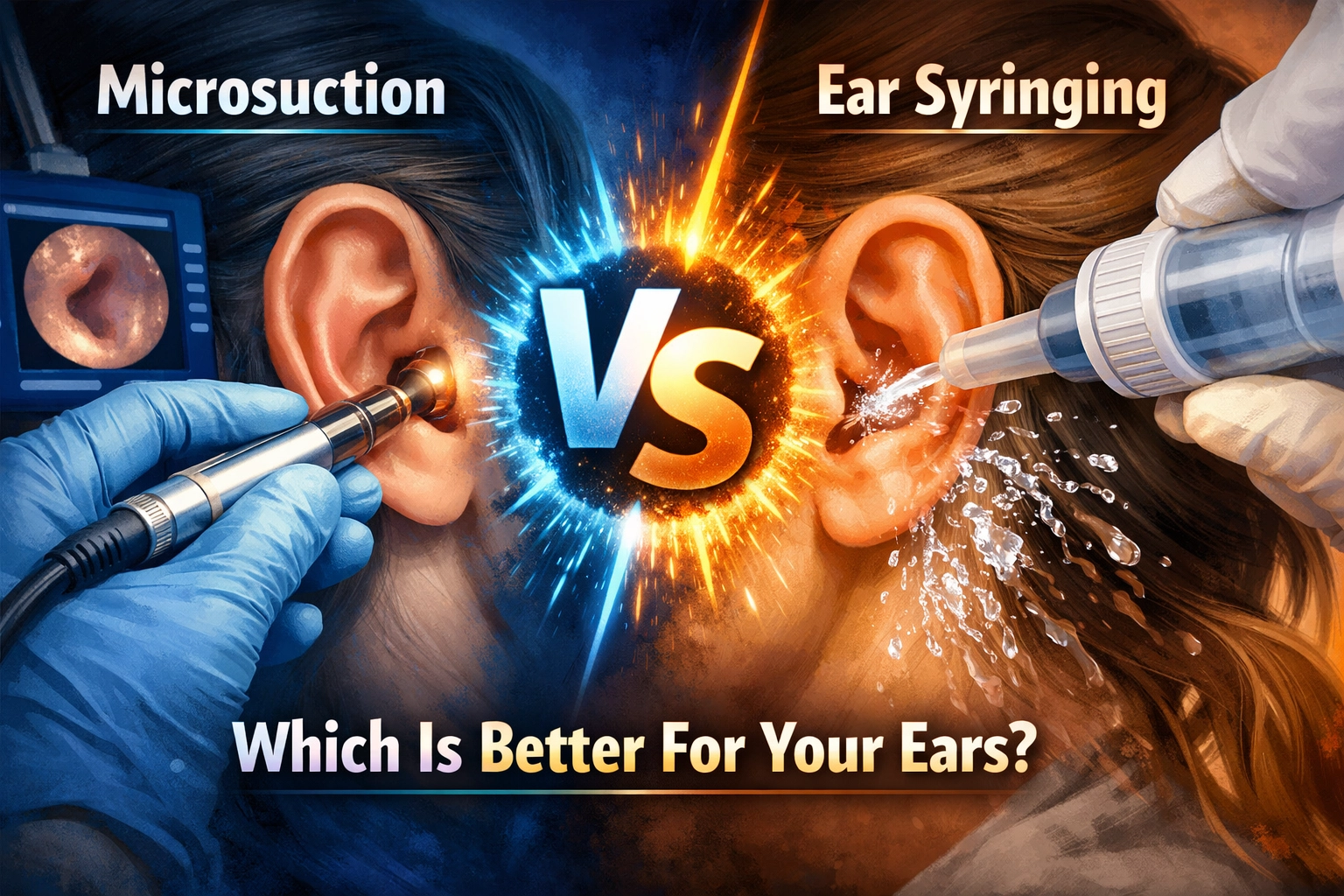
Ever felt like you’re living underwater? That muffled sound, the slight itch, and that nagging sensation that your ear is "full", it’s a different kettle of fish compared to a normal day, isn't it? When you finally decide you’ve had enough of the silence, you’re usually faced with a choice: the old-school ear syringing or the modern gold standard, microsuction.
But which one should you choose? Is one safer than the other? You might be asking yourself, "Does it really matter how the wax comes out, as long as it's gone?"
The short answer is: Yes, it matters. A lot.
At Ear Suction Clinic, we’ve seen over 10,000 happy patients walk through our doors in Perth, and we’ve heard the horror stories of DIY attempts and outdated methods. Today, I’m going to break down the "battle of the methods" so you can make the best decision for your hearing health.
The Old Guard: What is Ear Syringing?
For decades, ear syringing (now more technically known as ear irrigation) was the go-to method for GPs. You probably remember it: a large syringe (or an electronic irrigator) used to pump warm water into your ear canal to "flush" the wax out.
It sounds simple enough, right? Use water pressure to push the blockage out. But here’s where things get a bit dicey.
The Hidden Risks of Water Pressure
When you squirt water into an ear canal that is already blocked by a wall of wax, that water has to go somewhere. If it gets trapped behind the wax, the pressure can build up against your eardrum.
I hear you ask, "Is it really that dangerous?"
Well, research shows that complications occur in about 1 in every 1,000 ears irrigated. While that might sound like a small number, the complications themselves are anything but small. We're talking about:
- Perforated eardrums: In about 19% of complication cases, the eardrum actually ruptures from the pressure.
- Otitis externa: This is a fancy way of saying a painful outer ear infection caused by moisture being trapped in the canal (22% of complications).
- Failure to remove wax: Believe it or not, syringing fails to clear the blockage in about 37% of cases, often just pushing the wax deeper or making it soggy and more uncomfortable.
Plus, if you’ve ever had a perforated eardrum in the past or have ear tubes (grommets), syringing is a total no-go. Introducing water into the middle ear through a hole is a recipe for a massive infection.

The New Gold Standard: What is Microsuction?
Now, let’s talk about the modern way we do things here at Ear Suction Clinic. Microsuction is essentially a tiny, medical-grade vacuum for your ears.
Instead of blindly flushing water into your ear, we use a high-powered microscope to look directly into your ear canal. This gives us a crystal-clear, magnified view of exactly where the wax is and what’s happening with your eardrum. Then, using a fine suction wand, we gently remove the wax.
Why It’s the Safer Choice
The biggest advantage? It’s a "dry" procedure.
Because we don't use water, there is no risk of moisture-induced infections. It’s also significantly safer for people who have perforated eardrums or a history of ear surgery. In fact, a 2017 study found that microsuction had a significantly lower rate of complications compared to ear syringing, with only 1.2% of patients experiencing any minor issues, and most of those were just temporary "ticking" or a slight dizzy spell that vanished in minutes.
Key benefits of microsuction include:
- Immediate relief: You walk in blocked and walk out hearing the world in high definition.
- Precision: We see exactly what we are doing. No guesswork.
- No Mess: Unlike syringing, you won’t leave with a wet shirt or water sloshing around in your head.
- Speed: Most appointments take just a few minutes per ear.
Myth vs. Reality: Does Microsuction Hurt?
You’re probably asking yourself, "A vacuum in my ear? That sounds loud and painful!"
Let’s clear the air. Is it loud? It can be. It sounds a bit like a tiny wind tunnel inside your head. Is it painful? Generally, no. Most of our patients describe it as a "weird but satisfying" sensation. Some people even find it relaxing (though I wouldn't go as far as calling it a spa treatment!).

Occasionally, if the wax is very hard and stuck to the skin of the ear canal, there might be a moment of discomfort, but it's over in a flash. This is why we always recommend using wax-softening drops for a few days before your microsuction ear wax removal appointment. It makes the "vacuuming" process much smoother.
The Side-By-Side Comparison
If you're still on the fence, let’s look at the "tale of the tape":
| Feature | Ear Syringing (Irrigation) | Microsuction |
|---|---|---|
| Method | Water pressure | Gentle suction |
| Visibility | Blind (cannot see the wax during flushing) | Direct vision via microscope |
| Infection Risk | Higher (due to moisture) | Very low (dry procedure) |
| Perforation Risk | Present (pressure-related) | Negligible |
| Safe for Perforated Ears? | NO | YES |
| Immediate Results? | Usually, if it works | Yes, 99% of the time |
| Mess Factor | High (water/towels needed) | None |
Why Perth Locals Choose Ear Suction Clinic
We aren't just any clinic. We are Perth's ONLY 5-star rated Microsuction Earwax Removal Clinic. When you've dealt with over 10,000 patients, you learn a thing or two about ears. We’ve seen it all: from "packed to the rafters" wax blockages to the accidental cotton bud tip stuck against an eardrum (ouch!).

When you come to see us, you aren't just getting a procedure; you're getting peace of mind. Our clinicians are experts in the anatomy of the ear, and we use the latest technology to ensure your visit is safe, quick, and effective.
"Back up a minute: can't I just use a cotton bud?"
I know, I know. They are sitting right there in the bathroom cupboard. They look so innocent. But stop right there!
Using a cotton bud to clear a blockage is like trying to get a cork out of a wine bottle by pushing it inward. You might get a tiny bit of yellow on the tip, which makes you feel like you've achieved something, but in reality, you’ve likely just compressed the rest of the wax against your eardrum. This makes it harder for us to remove later and increases your risk of a painful infection or a punctured drum.
Trust me, we’ve seen the results of "DIY ear surgery," and it’s never a pretty sight. (Check out our FAQ for more on why you should bin those buds!)
Preparing for Your Visit: The Pro Tips
To get the best results and ensure a 10/10 experience, here’s what you should do:
- Use Oil: Put two drops of olive oil or Earol in the affected ear(s) twice a day for 2-3 days before your appointment. This softens the wax and makes the suction process incredibly easy.
- Don't Poke: Whatever you do, don't try to "prep" the ear by digging around yourself.
- Check Your History: If you’ve had ear surgery in the past, let us know! Microsuction is safe, but it's always good for our clinicians to know the "lay of the land."

Summary: Your Ears Deserve the Best
At the end of the day, your hearing is precious. While syringing was the standard for a long time, the medical community is moving toward microsuction for a reason: it is simply safer, cleaner, and more effective.
Don't let a blocked ear ruin your week or put you at risk of a perforated eardrum from outdated irrigation methods. Experience the immediate relief that over 10,000 of our patients already have.
If you’re ready to hear clearly again, book your appointment now. We’ll have you in, out, and hearing the birds chirping in no time.
Stay safe and keep those ears clear!
Keywords: microsuction vs ear syringing, ear wax removal Perth, safest ear cleaning method, professional ear suction, blocked ear relief, ear irrigation risks, Ear Suction Clinic Perth, microsuction benefits.
3 Comments
Aisha2098
April 12, 2026https://shorturl.fm/f9xUR
Jake3396
April 23, 2026https://shorturl.fm/ADLNS
reviewer_b4828668
July 2, 2026Great product, highly recommended! [b4828668]